
Small Business Marketing Agency: How to Choose One That Delivers

The right small business marketing agency does more than send you traffic. It builds one system that finds prospects, qualifies them, books the call and shows you which dollars produced paying clients. That is the standard to hold any agency to, and it is how we build campaigns at Market Movers: one accountable team, with every campaign tracked from first click to closed deal. This guide covers what agencies actually do, what they cost, how to test their reporting and what to prepare so the first 90 days count.
TL;DR
- A good agency is judged on qualified leads, booked calls and closed deals, not clicks, impressions or followers.
- Budgets vary widely by channel. Social management, SEO and paid ads are priced differently, so ask for a scope and a monthly number before comparing.
- Agree in writing what a “qualified lead” is, and make sure every lead can be traced from its source to the CRM.
- Insist that the accounts, content and automations are built in your name, so you keep them if the relationship ends.
- Prepare your offer, your best client profile and your sales follow-up before kickoff. The agency can only multiply what already works.
Table of Contents
- What a small business marketing agency actually does
- When an agency beats doing it yourself
- What small business marketing services cost
- How leads become customers: the tracking that matters
- How to vet an agency before you sign
- Services that fit your type of business
- What to prepare before you start
- How we work with small businesses
- FAQ
- Sources
What a small business marketing agency actually does
An agency takes over the channels that bring in new customers and runs them as a team. For a small business that usually means some mix of search engine optimization (SEO, the work of ranking in Google), paid ads on Google and Meta, social media, email, content, website conversion and lead follow-up.
What owners hand off first is telling. An April 2025 survey of 500 US small business owners found that the services they outsource most are social media management, email marketing and paid search. The same survey found that 52% outsource at least some marketing, and that 40% of those who outsource end up leaving, with 56% of the leavers going within 6 to 12 months.
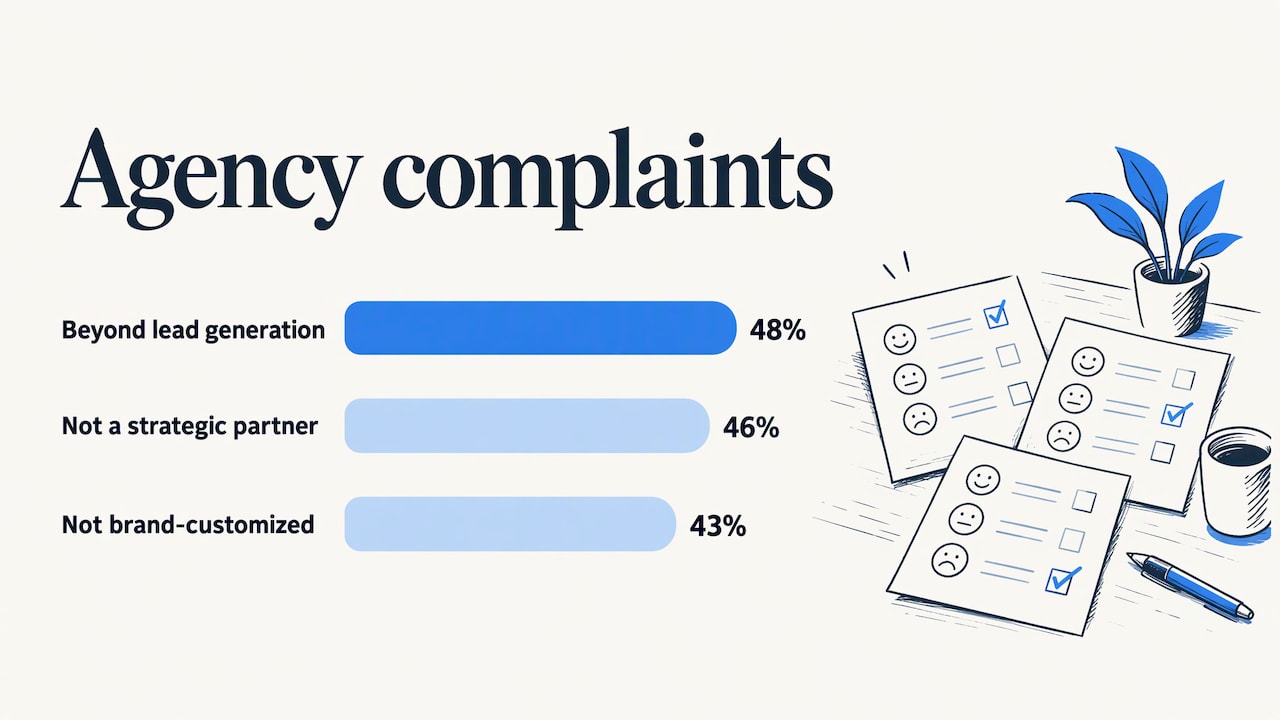
That churn figure is the reason this decision deserves care. Owners rarely leave because a channel was missing. They leave because they could not see what the money produced. A 2021 survey of 600 US small business owners put numbers on it: the top complaints about agencies were being unable to help beyond lead generation (48%), not acting as a strategic partner (46%) and programs that were not customized to the brand (43%).
Read those three complaints as a spec sheet. You want an agency that:
- Covers the whole path from the first click to the signed client, not one slice of it.
- Treats your numbers as the goal, not its own deliverables.
- Builds around your offer, your market and your sales process.
When an agency beats doing it yourself
Most small business owners start by running marketing between client work. That works until three things happen: the channels multiply, the leads arrive faster than anyone can follow up, or no one can say which channel the last five clients came from.
An agency fits when your growth depends on several moving parts at once. A law firm, for example, needs local search visibility, a website that converts, intake that answers quickly and ads that do not waste budget on the wrong case types. One person rarely has time to be the SEO specialist, the ad buyer, the copywriter and the CRM administrator. A team with each skill under one roof, accountable for a single result, removes the handoffs where leads get lost.
A useful test: if you can describe your marketing as one channel and one goal, a narrow tool may do. If you are asking how SEO, ads, email, webinars and follow-up should work together, you are asking an agency question.
What small business marketing services cost
Prices depend on the channel, the competition in your market and how much work the agency does for you versus alongside you. The published benchmarks show why a single “average price” is misleading.
| Service | Published benchmark | Source |
|---|---|---|
| Social media platform management | Average retainer of $3,000 per month across 220 agencies surveyed | Sprout Social agency pricing report |
| Overall outsourced marketing | Average monthly outsourcing budget of $7,560 in a 2021 to 2022 study of 100+ US businesses | Semrush agency hiring study |
Treat these as ranges to calibrate your expectations, not quotes. They come from different years and different samples, and your own number depends on three things:
- Scope. Ranking in Google, running ads and managing a webinar funnel are different workloads. The more channels, the larger the retainer.
- Competition. A personal injury firm in a large metro bids against many rivals for the same clicks. A regional home service company usually does not.
- Ad spend. Media spend goes to the ad platforms. Ask whether the agency fee is separate from it, and how the agency is paid as spend grows.
The Semrush study also shows how businesses judge agencies once they hire them: ROI (41.4%) and cost per lead (31%) lead the list. Both only work if the agency tracks leads to revenue, which is the next section.
Before you request proposals, the BBB advises writing a list of the services you need and setting a maximum budget. The national ANA and 4A agency search guidelines say the same in a different way: give candidates a budget range rather than a single figure, and discuss compensation early. A range lets agencies propose what is realistic instead of guessing.
How leads become customers: the tracking that matters
This is where agencies differ most, and where you can tell quickly whether one is worth hiring. A lead form fill is not a customer. An agency that reports only form fills is reporting its own activity.
Define a qualified lead in writing
Agree with the agency, before the first report, what counts as a qualified lead: the type of client, region, role, budget or timeline, and who signs off. A reporting guide for B2B agencies makes the point that lead reporting only survives a sales conversation when the definition is agreed in writing before the first report. Without it, the agency and your intake team will argue about the same list of names.
Follow every lead from source to signed client
Every lead should carry a source identifier, such as the ad click ID or a campaign ID, into your CRM (the system where you track prospects and clients). That one habit lets you see which channel produced the signed client, not just the inquiry.
It also changes how ad platforms behave. They optimize toward whatever the tracking tag counts. If the tag counts form fills, Google and Meta treat a junk lead and a $50,000 deal the same. Passing qualified and closed deals back to the platforms teaches them to look for more of the leads that pay.
Work backward from the number of clients you want
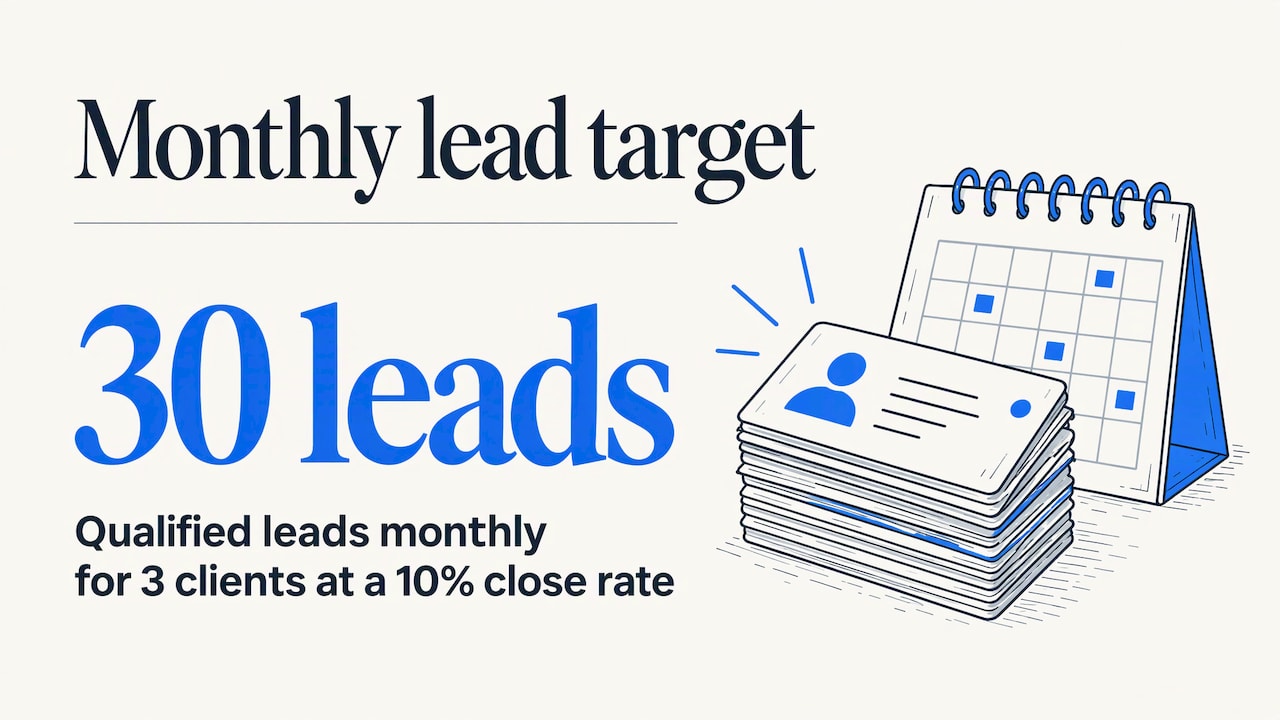
A simple planning method: decide how many new clients you want, then divide by your close rate to find the leads you need. HubSpot’s agency guide illustrates it with a $15,000 average project and a 10% lead close rate. At 10%, you need ten leads for each client, so a goal of three new clients a month means about thirty qualified leads. If your close rate is lower, the number rises. Knowing it makes any proposal easier to judge.
What to look for in monthly reporting
Ask for these numbers each month: cost per qualified lead, share of leads that were qualified, leads that became opportunities, pipeline created, and signed clients by channel. Reports that stop at clicks and impressions leave out the part you are paying for.
At Market Movers, every campaign is tracked from first click to closed deal, so the owner sees what is working at each stage, through booked calls and signed clients.
How to vet an agency before you sign
The BBB’s guidance for choosing a marketing agency boils down to questions you can ask in a first call. Use them as a scorecard.
- How do you measure campaign effectiveness? The answer should name leads, booked calls and closed deals, not only traffic.
- Have you worked in my industry? Industry experience shortens the learning curve on your audience, your compliance limits and your sales cycle.
- Who will work on my account? Ask for names and roles, not just a team page.
- Do I own everything you deliver? The BBB lists content ownership among its questions. Extend it to ad accounts, analytics, CRM setup and automations.
- How is confidentiality handled? Especially relevant for law, healthcare and financial firms.
- What is in the contract? Read the full agreement, fine print included, before signing. All of this appears in the BBB’s agency selection guidance.
Then look at evidence of results. The ANA and 4A guidelines tell agencies to present case studies in terms of business results, since awards matter only if the recognized work increased the client’s business. They also advise explaining why a given metric was chosen. Apply that to what you are shown. A strong case study states the starting point, the metric, the result and the time it took.
Our own results are published on our case studies page. They include a $2M pipeline for Cogent Law, a 4.5× return on ad spend for Solkoff Legal and $100K+ in enrollments for Elder Law College.
Finally, ask about ownership in plain words: if we part ways, what do I keep? Our approach is that the campaigns, automations, content, data and tools are documented and stay in your own accounts. That is a reasonable standard to ask of any agency.
Services that fit your type of business
The right mix depends on how your clients decide to buy.
- Law firms and solo attorneys. Clients search when they have a problem and compare firms before calling. Search visibility, including how your firm appears in AI search answers, plus a conversion-focused site and fast intake carry most of the weight. Our law firm SEO and AI search work is built for this path.
- Professional services, consultants and financial advisors. Trust and expertise sell the work. Webinars, content and outbound email put you in front of the right buyers before they are ready to buy.
- Healthcare practices and clinics. Local search, reviews and a smooth booking process matter most, along with careful handling of patient information.
- Home service companies, real estate agents and local businesses. Local search and paid ads capture ready-to-buy customers. Speed of follow-up decides who wins the job.
- Coaches, course creators and B2B or SaaS companies. Launches, webinars and cold email build a pipeline of qualified buyers. For launches, see our course launch marketing.
Whatever your category, the agency should adapt the plan to you. Programs not customized to the brand ranked among the top complaints in the survey above, and a template plan is the most common cause.
What to prepare before you start
Agencies multiply what already exists, so a few hours of preparation raise the return on the first months.
- Your offer. Write down what you sell, to whom and at what price. Be specific about the case types or services you most want more of.
- Your best clients. Describe the last five you were glad to win: who they were, how they found you and what they were worried about.
- Your numbers. Know your close rate, average client value and how many new clients you can handle each month.
- Your follow-up. Decide who answers new inquiries, how fast and what they say. Leads that wait lose value quickly.
- Your access. Gather logins to your website, analytics, ad accounts and CRM, and keep ownership of each in your name.
- Your budget range and goal. Share a range rather than a single figure, as the ANA and 4A guidance suggests, along with the outcome that would make the engagement a success.
If some of this is missing, such as intake workflows or a CRM, a full-service team can build it as part of the engagement.
How we work with small businesses
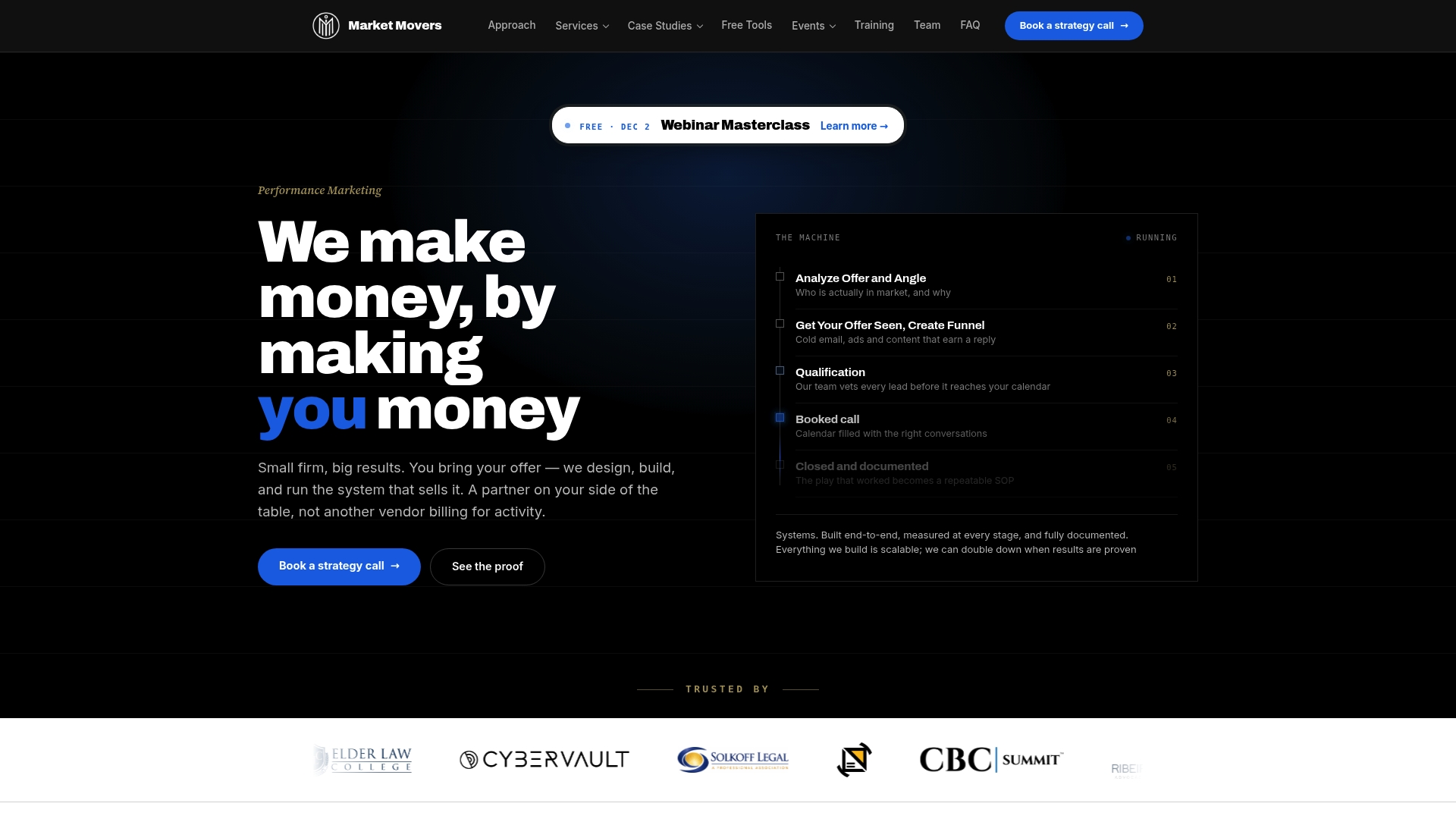
Market Movers is a full-service marketing agency that does lead generation for you. We combine SEO, AI search visibility, webinars, cold email, Google and Facebook ads, social media and content into one client acquisition system. One accountable team builds and runs it, and measures each stage from the first click through booked calls to closed deals.
We specialize in law firms and professional service businesses, and we also work with local businesses, healthcare practices, coaches, course creators and B2B companies. If you want to see how the system would look for your firm, start at mktmovers.com, or see how done-for-you webinars turn expertise into booked calls.
FAQ
How much should a small business spend on a marketing agency?
It depends on scope and competition. One study of US businesses found an average outsourcing budget of $7,560 per month, while single-channel work such as social media management averages less. Set a range based on the value of a new client and the number of clients you want, then ask each agency what that range can realistically cover.
What should a marketing agency report each month?
At minimum: cost per qualified lead, qualified-lead rate, opportunities, pipeline created and signed clients by channel. Reports that stop at clicks and impressions do not show whether marketing is paying for itself.
How long before a small business sees results?
Paid ads and outbound campaigns can produce inquiries within weeks, while SEO usually builds over months. Ask any agency for a written 90-day plan that states what will be launched, what will be measured and when you will review results.
Do I need to own the ad accounts and content?
Yes. Ownership of accounts, content and automations is one of the questions the BBB suggests asking, and it protects you if the relationship changes. At Market Movers, the campaigns, automations, content, data and tools are documented and remain in your own accounts.
Is a marketing agency right for a very small or solo business?
It is when growth depends on several channels working together and you do not have time to run them. A solo attorney or consultant with a clear offer can gain a complete lead system without hiring a team of specialists.
Sources
- Marketing Management: Why SMBs Hire Marketing Agencies (MarketingProfs, April 2025)
- What small businesses need from marketing agencies today (2021 survey report)
- Sprout Social agency pricing and packaging report
- How Businesses Hire Agencies (Semrush study)
- BBB Business Tip: Choosing the right marketing agency
- ANA/4A’s Guidelines for Agency Search
- Client Reporting for B2B Marketing Agencies (ReportsMate)
- Best Conversion Tracking Software for Lead Gen (Attribi)
- The Advanced Guide to Building a Lead Generation Campaign (HubSpot)